lunedì 7 settembre 2009

Emulatore: vietato emulare quella ciofeca di Basic V2

clipped from c64.manomio.com

KEY FEATURES:
- Original Commodore 64 game graphics
- Original SID sound
- Auto-save, to continue exactly where you left off
- Realistic joystick and beautifully crafted C64 keyboard
- Portrait and Landscape play
- Vertical and Fullscreen gaming (auto rotate for iPod users)
- and much more...

Per essere accettato su App Store, l'emulatore del Commodore 64 non doveva emulare il suo interprete di linguaggio Basic v2 (quello famoso per il tragicomico messaggio "64K RAM SYSTEM 38911 BYTES FREE").

Evidentemente alla Apple hanno il terrore che qualche proprietario di iPhone si metta a scrivere software in quella allucinante ciofeca di Basic Commodore 64, noto per la sua terrificante rozzezza e per la sua allucinante lentezza!

venerdì 4 settembre 2009

About Apple’s Security Foundations, Or Lack Of Thereof.

Every once in a while it’s healthy to reinstall your system... I know, I know, it’s almost a heresy to say that, but that’s reality in the world where our systems are totally unverifiable. In fact I don’t even attempt to verify if my Mac laptop has been compromised in any way (most system files are not signed anyway). But sometimes, you got this feeling that something might be wrong and you decide to reinstall to start your (digital) life all over again :)

continua qui.........


CIOs hit the snooze button on Snow Leopard

The most talked about new feature in Mac OS X Snow Leopard, which debuted on August 28, is its native integration with Microsoft Exchange. The assumption was that this one feature could have the same kind of impact in opening the Mac market to corporate users as Exchange integration had on bringing the iPhone to business professionals. A new survey of TechRepublic’s CIO Jury completely debunks that assumption.

On September 1, TechRepublic polled its 90-member panel of U.S. IT executives and asked, “Does the release of Snow Leopard make your IT department more likely to adopt more Mac OS X machines?” The jury, made up of the first 12 respondents, unanimously voted “no” in a 12-0 decision.

Continua qui..........


giovedì 3 settembre 2009

Apple ships vulnerable Flash version with new Mac OS

Snow Leopard leaps out of the box but forgets to bring an update to Adobe's multimedia program, potentially putting users at a higher security risk

Continua.............


mercoledì 2 settembre 2009

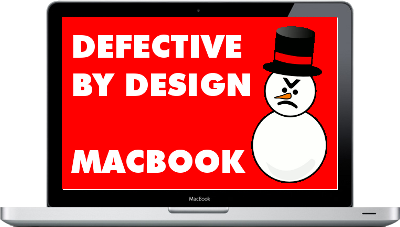
MacBook: ''disconnettere monitor non autorizzato!''

clipped from static.fsf.org
http://static.fsf.org/dbd/days/01/001-macbook-defective.png
clipped from static.fsf.org
http://static.fsf.org/dbd/days/01/001-macbook-green.png
clipped from arstechnica.com
Tra novembre 2008 e gennaio 2009 scoppiò la famosa polemica sui MacBook che si rifiutavano di visualizzare video su display "non autorizzati".

Insomma, compri un computer Apple, compri un film, e alla fine è ancora Apple a decidere se puoi visualizzarlo e dove puoi visualizzarlo...!

L'articolo di ArsTechnica è illuminante.

Promesse da marinaio?

"If you legally acquire music, you need to have the right to manage
it on all other devices that you
own.
" --
Steve Jobs, May 2002

Steve Jobs: Head in the sand

And yet, here we are, over 6 years later, and Steve Jobs's Apple is the only major vendor of digital music that is actively preventing this.

"Se compri legalmente musica, devi avere il diritto di utilizzarla su tutti gli apparecchi che possiedi".

Già.

Ma oggi, nel 2009, quanto è ancora valida in Apple quella dichiarazione (che è una promessa)?

Anche Hack-a-day si fa beffe di Slow Leopard

clipped from hackaday.com
snow_leopard_fake_math

We’ve always felt that hard drive manufacturers were dirty crooks because of their use of fake math to make drives sound bigger than they actually are. Here’s a quick refresher for those who need it: Because digital information consists of 1’s and 0’s (two possible settings), digital architecture revolves around powers of 2. Long ago, when nomenclature was setup for measuring data the term kilobyte was adopted to represent 2 to the 10th power bytes (base 2, aka real math). The problem here is that 2^10= 1024 and when laymen hear the root “kilo” they think 1000 which is 24 byes less (base 10, aka fake math). So, if you have a 500,000,000 byte drive, base 10 math would call that a 500GB drive, but base 2 math would call that 476.8GB.

it may at first be difficult to understand why Apple would change to a base 10 system. But think about it once more, doesn’t Apple have a lot to gain if all the storage-containing-hardware they sell sounds bigger than it actually is?
Anche Hack-a-day prende in giro Slow Leopard, il leopardo con la forfora che per far sembrare più grandi gli hard disk cambia unità di misura...

Ma pensateci un attimo: la Apple non ha forse tanto da guadagnare se tutto l'hardware dotato di storage (che loro vendono) sembra più grande di quello che in realtà è?

Cinque ragioni contro l'iPhone

iPhone completely blocks free software. Developers must pay a tax to
Apple, who becomes the sole authority over what can and can't be on
everyone's phones.

iPhone endorses and supports Digital Restrictions Management (DRM)
technology.

iPhone exposes your whereabouts and provides ways for others to
track you without your knowledge.

iPhone won't play patent- and DRM-free formats like Ogg Vorbis and
Theora.

iPhone is not the only option. There are better alternatives on the
horizon that respect your freedom, don't spy on you, play free media
formats, and let you use free software -- like the
FreeRunner.

1) l'iPhone è totalmente allergico al free software; gli sviluppatori devono pagare una "tassa Apple" per poi magari vedersi rifiutati i propri lavori; la Apple decide cosa puoi avere nel telefono e cosa no

2) l'iPhone è imbottito di DRM

3) l'iPhone ti fa tracciare senza che tu lo sappia

4) l'iPhone non supporta formati free e no-copyright come OGG Vorbis e Theora

5) ci sono alternative all'iPhone: altri telefoni che rispettano la tua libertà, non ti spiano, riconoscono formati non coperti da copyright e DRM, ti permettono di usare software free... uno di questi è il FreeRunner OpenMoko.

martedì 1 settembre 2009

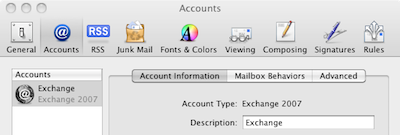
Apple Snow Leopard and Exchange: the real story

Apple’s Snow Leopard (OS 10.6) came out last week, and one of its most hyped features is native support for Microsoft Exchange. Here’s what Apple says:

With Snow Leopard, the Mac is the only computer with built-in support for the latest version of Microsoft Exchange Server. So you can use your Mac — with all the features and applications you love — at home and at work and have all your messages, meetings, and contacts in one place.

What this means is that eager Mac users will be upgrading to Snow Leopard and expecting to be able to connect to Exchange at work with Apple-style “it just works” ease of configuration.

The truth is more complex; and I’m disappointed with both Apple’s publicity and the number of reviews that have simply reported its claims without investigation. That said, it is a tricky subject, and I have some sympathy with Apple, which is doing more or less the right thing at a technical level.

Configuring Snow Leopard Mail to use Exchange

Continua qui.......


Dovella aveva ragione

clipped from www.macitynet.it
occupa meno spazio sul disco fisso ma una piccola parte del maggiore spazio disponibile che gli utenti si ritrovano è dovuta anche a un altro fattore: in Snow Leopard cambia l'unità di misura delle dimensioni dei dischi. Il perché è spiegato in un documento di Apple.

In sostanza fino a Leopard la capacità del disco fisso del Mac è stata misurata in base binaria così una chiavetta USB per esempio da 4GB era vista come una unità da 3,7GB. La discrepanza tra la capacità dichiarata dal costruttore (del disco o della periferica) e quella rilevata da Mac OS X era dovuta al fatto che i costruttori indicano sempre la capacità in scala decimale. 1GB è sempre un GB comunque lo si misuri, in scala binaria o decimale: lo spazio disponibile per l'utente non cambia, le due misurazioni però non collimano. 1GB in scala decimale è pari a 1 miliardo di byte, mentre 1GB in scala binaria è 1miliardo 73milioni e 741.824 byte: la differenza è illustrata in questo documento del supporto di Apple.

Slow Leopard: noticina in caratteri microscopici (della serie: "finalmente lo ammettono"):

...una "piccola parte del maggiore spazio disponibile" è dovuta all'unità di misura dei dischi...

Che prima li chiamavano 3,7Gb e ora li chiamano 4Gb.

Oppure, prima li chiamavano 370Gb e ora li chiamano 400Gb: poffarbacco! Slow Leopard fa guadagnare Trenta Giga!

E poi avevano il coraggio di criticare Dovella...

Ma che Maccaroni!!!